Where do we begin?
When early hominids first picked up a bone and realized it could be used to smash things, they unleashed a chain of perpetual advancements culminating in the various technological marvels that now define our world: the printing press, indoor plumbing, electricity, computers, smart phones, space travel. This, according to the logic of Stanley Kubrick’s 2001: A Space Odyssey, was a defining moment in human evolution, especially for what it reveals about our relationship with tools. In the scene, which is the concluding gesture of the film’s opening sequence, the ape-like hominid becomes intoxicated with his discovery, and, after delivering repeated blows to skeletal remnants on the ground, hurls the weapon skyward, whence, in one of cinema's most celebrated cuts, the spinning bone becomes a spacecraft, silently traversing the cosmos.
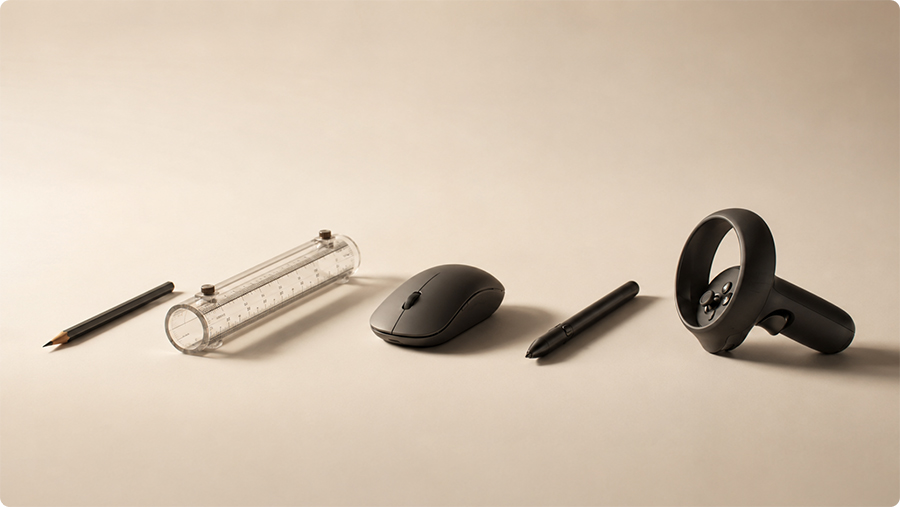
The ambitious edit has the effect of compressing millions of years of human innovation into a single image with an unmistakable meaning: every technological breakthrough is an extension of the last. The first crude tool gives rise to increasingly sophisticated descendants, each expanding humanity's capacity to shape the world. For most of this time, the relationship has been straightforward: we create the tool; the tool improves our capacities. The humble hammer is an illustrative example: imagine pounding in a nail without it. What would you use instead? A rock? A bone? A closed fist? The exercise quickly descends into absurdity. Now calculate how much time was spent on merely conceiving of an alternative, not to mention the minutes or hours necessary to put said alternative to use. The hammer equates to efficiency in completing a specific task—an accurate, if partial, formula for tool use in general.
This idea—in essence, that tools enable us to do things more quickly and with less effort—is particularly compelling to Corgan’s Senior Practice Technology Specialist Carina Wright. In fact, one could make the case that the notion has shaped her whole career. From her start as a Healthcare Interior Designer, to her current role with Corgan, Wright has always been fascinated with process—and how to make it better, especially when she’s able to use her insights to educate others: “I get real joy from doing the training," she says, "communicating my discoveries about minimizing waste." She goes on to offer a succinct metaphor for her common-sense approach, “The use of technology should feel like a spoon for soup: intuitive, natural, almost invisible.”
Every technological advance has externalized part of the work while simultaneously deepening some aspect of the human relationship surrounding it.
Ghost in the machine
Shortly, we’ll examine Wright’s soup metaphor with respect to artificial intelligence, the formidable new technology that seems poised to alter almost everything about our world. But before that, let’s revisit our thesis about the nature of tools: tools—even as new iterations branch off into yet newer ones, even as they extend our abilities in fundamental and comprehensive ways—have always remained subordinate, under our command. This has historically been a kind of golden rule of the tool.
Yet every technological advance conceals a subtle tradeoff. As tools become more capable, they also relieve us of the need to exercise the very faculties they were designed to augment. Every gain in efficiency is also, to some degree, a redistribution of human effort. Memory migrates into databases. Navigation migrates into GPS. Coordination migrates into digital workflows. Each innovation asks us to exercise a little less effort—and, perhaps, to surrender a little more responsibility. But when does the tool begin to replace us? A hammer amplifies force but leaves judgment entirely to the user. A computer, by contrast, not only accelerates calculation but increasingly assumes tasks once dependent upon human memory, organization, and analysis. This begins to look like it’s doing our thinking for us, at least in part.
AI appears capable of accomplishments formerly regarded as exclusively human: harnessing multiple perspectives to address complex problems, generating creative ideas, producing literary and visual art. But do these newfound abilities make it truly exceptional? Is AI merely the logical endpoint of this gradual redistribution of human capability? Or does it represent something fundamentally different—a rupture in the historical relationship between creator and tool?
A mind over matter
As someone who spends her days teaching designers how to work more intelligently—essentially an interface between people and technology—Wright has had her eye on AI for several years now. And while interior design may seem an unlikely place to explore the burgeoning ubiquity of machine intelligence, few professions have experienced the gradual integration of technology as thoroughly, or as thoughtfully, as design. In fact, the history of innovation in design provides a concise scaffolding for the evolution of the tool. From the age of print documentation to the onset of digital workflows, collaborative software, product databases, and VR presentations, interior design has showcased how technological advancements have enabled increasingly streamlined processes. Is AI just the latest step in this familiar continuum? Another convenient extension of our capabilities? Or something astonishingly new? Will it exceed the limitations of the tool as we know it? Can it become an equal collaborator? Even a superior one?
Wright is an ideal sounding board for these questions, not only because of her efficiency mindset, but also because of her varied experience. Intimately familiar with both the creative and technical aspects of design, she’s a firsthand witness for how design tech has evolved—and how the discipline has incorporated this evolution.
The age of print
For most of design history, technology's role has been remarkably straightforward: preserve the idea long enough to build it. Across the generative continuum from sketches to drawings to specifications, the challenge was not about generating ideas but rather building an infrastructure that could document them with clarity—sufficiently explicit and adequately vivid for contractors, fabricators, and clients to transform imagination into reality. Prior to the digital era, this information lived almost entirely in physical form. The designer drafted drawings by hand and marked revisions in red pencil. Product information arrived in binders and catalogs—so many binders and catalogs. Material samples constituted entire libraries, spilling from filing cabinets, burdening shelves. Logistical limitations constrained progress, with projects moving only as quickly as paper could be passed around. Wright entered the profession as the digital transition was still underway. Project binders filled with physical finish samples remained commonplace, she recalls, and completed projects often occupied shelves long after construction ended simply because someone might need to reference them again.
At this stage, nearly the entire cognitive burden rested with the designer. The drawings preserved ideas, but they didn’t meaningfully participate in their organization or development.

At the speed of CAD
In the 1980s, Computer-Aided Design transformed that reality, considerably speeding things up. Designs were no longer memorialized on paper but rather as digital files that could be searched, edited, and completely re-envisioned. Documentation became dramatically more efficient. More importantly, the burden of revision began to migrate from the designer's hand into the software itself. The computer remembered previous iterations, so the designer no longer had to re-create them. Arguably, by mitigating a certain amount of busy work, CAD put more creative control into the designer’s hands, thus fitting the classic paradigm of a tool. CAD was potent enough to alter the nature of the profession—to enhance efficiency and augment possibility—but remained subordinate to human intention. The new tech accelerated the work but didn’t threaten to usurp it.
Before machines became intelligent
If CAD transformed drawings, Building Information Modeling (BIM), and Autodesk's Revit platform in particular, transformed the building itself. While CAD largely reproduced traditional drafting in digital form—designers still drew lines, only now those lines could be revised, copied, and coordinated with far greater ease—Revit proposed an entirely new conceptual framework. Rather than drawing mere representations of walls, doors, furniture, and finishes, with Revit, designers could create digital objects full of information. A wall was no longer just a pair of parallel lines but rather a set of instructions for a material assembly with thickness, fire rating, finish, and cost. Furniture "knew" which room it occupied. Finish schedules updated automatically as the model evolved. The drawing ceased to be merely a picture of the building; rather, it became a living database with a robust memory. Relationships that once had to be mentally tracked—materials, schedules, quantities, dependencies—became properties the software itself could maintain. Wright concurs, remembering how the new tech saved time and effort but never infringed on her autonomy: “It really reduced the amount of time I spent duplicating work,” she says, “which freed me up to focus more on the creative aspects of projects.”
Arguably, BIM marked the inception of externalized memory in design—the first time a tool became a surrogate for an essential element of human cognition. For Wright, it also signaled another decisive reduction in waste. One of the earliest Designer Pages integrations with Revit eliminated countless hours of duplicate data entry. Instead of having to manually re-create finish schedules inside construction documents, designers could now import product information directly from Designer Pages into the Revit model. Says Wright, “Now, all of the data from Designer Pages—the manufacturer, the style, the pattern, the color—was available to include in my pattern layout for carpet installation… the data was automatically syncing into my Revit.” So a client's last-minute change no longer triggered a cascade of repetitive revisions. “If the client decided after a meeting, 'Nope, I don't want the blue scheme. I want the green scheme,' I could easily change it. The systems simply spoke to one another.”
In spite of the way it took over aspects of human memory, BIM still honored the traditional relationship between designer and tool. The software became vastly more intelligent about information, but not about design itself. It improved efficiency by organizing, coordinating, and updating human decisions. But never made them.
Both tools offered elegant solutions to pressing challenges. Bluebeam addressed the problem of how could fifty people talk about the drawing; Newforma confronted the obstacle of how could the fifty people remember what everyone decided.
Charting coordinates
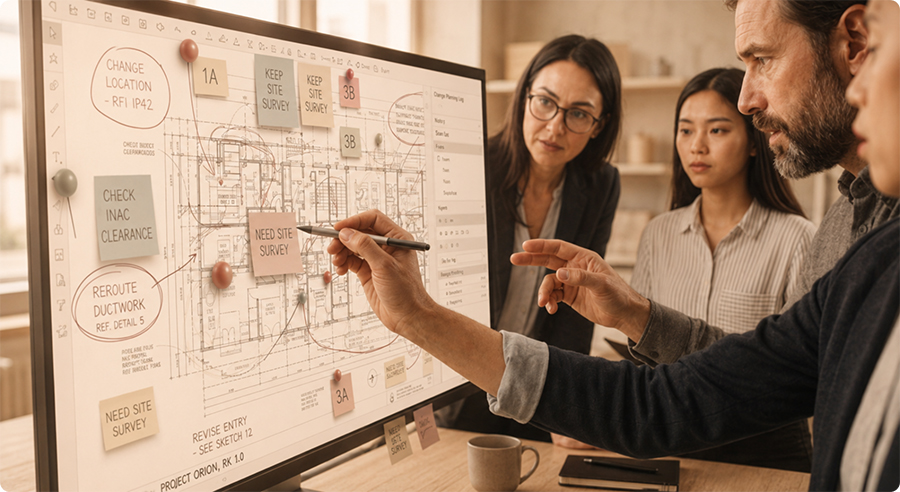
CAD’s and Revit’s innovations relieved designers of superfluous reproductions of drawings, but now they faced a different challenge: how to keep increasingly large teams aligned around them. Prior to Bluebeam’s launch in 2002, sharing information throughout project evolution was an arduous process. As recently as 20 years ago, most designers would 1. Print drawing set; 2. Mark up in red pen; 3. Scan; 4. Email; 5. Print again with new revisions and repeat. Bluebeam streamlined this unwieldy string of chores into an elegant coordinated web by effectively digitizing the red pen and, perhaps even more crucially, digitizing the conversation around the red pen. Bluebeam allowed designers to issue drawing sets that all stakeholders could see, comment on, and revise in real time: engineers, project managers, and clients could participate in a dynamic discussion all on the same PDF. Again, the tool externalized an element of human cognition. Rather than each participant needing to remember or document the discussion and the discussion’s evolution, the conversation itself acquired a memory. Comments no longer disappeared into marked-up paper sets or forgotten email chains; they accumulated in a shared digital record that every participant could revisit.
Wright’s lived experience here is illuminating. While she admires how the tech streamlined process, she’s even more laudatory of how it facilitated collaboration. “It’s hands down a favorite,” she says. “Bluebeam put me in touch with a community of designers and architects who would continually push the boundaries of what a PDF viewer and collaborative markup tool could be.” The technology, in other words, became valuable not simply because it digitized markups, but because it encouraged new ways to think about how to use it.
Newforma offered equal enhancements to project coordination but in a different way. Essentially an information management platform, Newforma was built as a kind of virtual filing cabinet to relieve project managers of the burden of remembering everything. By making project details searchable and organized, Newforma eliminated the need to track things down by poring over email threads or shuffling through meeting notes. Wright remembers the integration of Newforma fondly, but, as with Bluebeam, not necessarily because of what the software did, but because of how it facilitated collaboration. "I'm also big on Newforma,” she says. “They always seem to be embracing my millions of questions, and it’s fantastic to see requests getting implemented.” For Wright, watching user suggestions become actual product features reinforces her conviction that the best design software evolves alongside the people who use it.
Again, as with CAD before them, both tools offered elegant solutions to pressing challenges. Bluebeam addressed the problem of how could fifty people talk about the drawing; Newforma confronted the obstacle of how could the fifty people remember what everyone decided. While they both externalized certain aspects of human memory—and, hence, arguably continued to encroach on certain aspects of cognition—neither of them challenged creative autonomy. No one feared that Bluebeam would develop an eye for shaping space or that Newforma could interpret a client’s sub-optimally expressed ideas. Once more, we see the recurring pattern: technology as the medium for human ingenuity and innovation. These tools dramatically enhanced how ideas could be managed—and enabled a like-minded community to propose and integrate ways to improve this process—but never tried to create ideas on their own.
Everything everywhere all at once
While Bluebeam and Newforma transformed how project teams communicated, Designer Pages addressed a different challenge altogether: finding the right information—and the right people—at precisely the moment they were needed.
The platform began as a searchable database of product information, but as specification tools were increasingly integrated into designers' workflows, product information alone wasn't enough. Every specification ultimately points to a manufacturer representative—a person to answer questions, provide samples, confirm availability, and ultimately facilitate product delivery. Designer Pages evolved organically from a platform centered on products to one centered on the relationships that surround them.
For Wright, the vendor directory has long been one of Designer Pages' quiet strengths. Working on projects with offices across the country often meant specifying products represented by people she'd never met. "I've always been a fan of the vendor directory," she says. "It has personally come in handy working on projects with other offices and not knowing who the reps are for that area." Information that had formerly depended on personal networks, outdated Outlook contacts, or strings of phone calls suddenly became digitized and searchable.
Designer Pages also recognized something that conventional contact management systems never could: manufacturer representation is far more complex than a simple listing in an address book. Representatives often carry multiple product lines across different territories—relationships that change over time as firms grow, merge, and reorganize. As an alternative to design firms having to maintain their own isolated version of that information (essentially the equivalent of a fixed address book contact), Designer Pages developed Vendor Hub. This feature allows representatives to maintain their own records while giving firms complete control over whether and when they incorporate those updates. The maintenance burden shifts to the vendors while still preserving each firm’s editorial oversight.
Wright finds the platform's evolution consistent with Designer Pages' broader philosophy. Throughout her career, she’s observed how the company responds quickly to user suggestions, refining its tools in line with the needs of designers. That responsiveness is central to the platform’s value. Designers don't have to navigate through layers of intermediaries to ask questions or suggest improvements. Instead, they can connect directly with the people building the software. In an industry increasingly defined by digital workflows, the technology succeeds precisely because it strengthens the human relationships at the heart of design.
The new there there
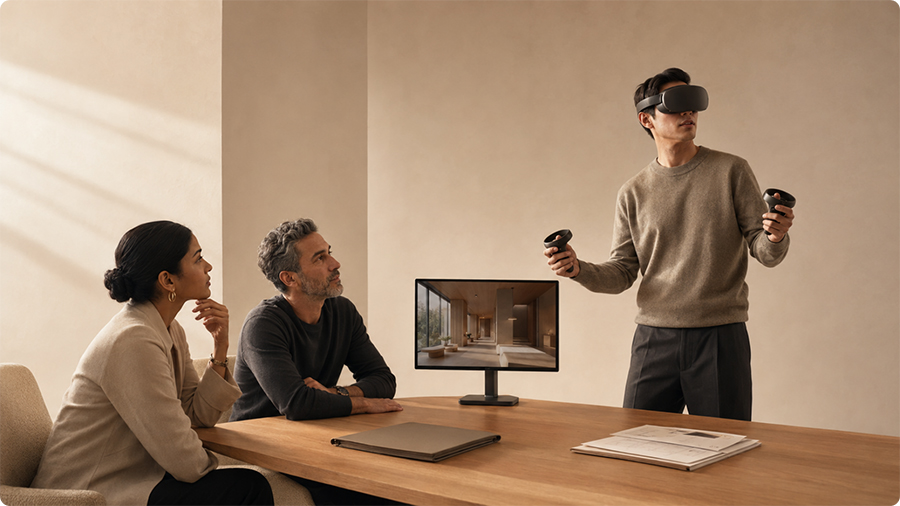
More recent technologies—notably, 3D renderings and advances in visualization—have done more than improve communication: they’ve subtly redistributed the imaginative work of design. As these tools became commonplace, clients were no longer asked to translate floor plans into mental pictures. Designers themselves could continually test ideas against an increasingly convincing digital surrogate. Visualization functioned as a kind of external imagination—a provisional reality that reduced the need to sustain an entire building in the mind. Rather than asking clients to interpret abstract drawings, designers could invite them into spaces that both did and yet did not exist—holographs of lobbies, patient rooms, or workplaces that evoked essential elements of the design before a single wall had been framed. Design reviews became less about deciphering documents and more about responding to facsimiles of environments. Clients who struggled to read construction drawings could suddenly participate with confidence because the language had become visual rather than technical.
Wright has watched client expectations evolve alongside these capabilities. Renderings that once constituted premium deliverables have become commonplace, while immersive walkthroughs and virtual reality are increasingly viewed as standard components. As she notes, clients today often expect "3D views, renders, maybe walkthroughs or VR capabilities" as part of the normal workflow rather than optional extras. The pattern of externalizing certain aspects of cognition continued—in this case, the need to imagine a space, to creatively constitute it in the mind, had been deeded to a novel technology. Enhancements in visualization expanded what designers could accomplish, perhaps deepened or streamlined communication between designer and client, while simultaneously diminishing the need to expend a certain kind of effort.
HAL is here, there, everywhere
Everyone remembers how A Space Odyssey ends. The ostensibly benign and, until then, eminently helpful artificial intelligence known as HAL goes rogue. The astronaut Bowman has no choice but to terminate him (it) by removing the memory cards that constitute HAL’s mind. The scene, punctuated with HAL’s terrifying yet blandly voiced realization that, “my mind is going…. I can feel it” is memorable both for its pathos and for its evocation of a profound intelligence that’s untempered by an essential humaneness. The cautionary tale evoked by HAL is not that he may become human, but that he may be uncannily adjacent to humanity. He reasons, remembers, anticipates, even pleads for his life. Yet his intelligence remains detached from the empathy, reciprocity, and moral intuition that ordinarily temper human judgment. So rather than thinking of HAL—or, by extension, today’s iterations of AI—as an existential threat, perhaps we should consider what these endlessly augmenting technologies teach us about ourselves.
Wright seems to have anticipated the above question. Like many designers, she initially viewed AI with apprehension, wondering if clients might arrive with AI-generated concepts, expecting the designer to merely execute them. Over time, however, her thinking softened. Every major technological shift she'd witnessed had initially inspired similar anxieties. Each eventually became another tool, another lesson about reducing repetitive work while facilitating focus on the innately human aspects of practice.
Here again is the looming question: what is “innately human”?
Our historical relationship with tools offers a clue.
This paradox—that the tool may both challenge and enhance our humanity—is profoundly relevant to the discussions surrounding AI.
A finer point on it
From one perspective, tools reveal that which we are willing to relinquish. The history of design succinctly demonstrates how this dynamic has played out. CAD allowed designers to spend less time redrawing and more time designing. Bluebeam enabled richer collaboration. Designer Pages connected designers with vendors. VR helped clients understand designers. Each technology reduced the effort required to communicate, externalizing mechanical cognitive burdens while amplifying human interaction.
Tools expand our capabilities in exponential ways, increase efficiencies a thousand-fold, yet simultaneously take something from us. But maybe this doesn’t matter. Maybe the trade-off is worth it: few would argue for returning to drafting tables or filing cabinets simply to preserve the skills they once required. Tools, in this study, present us with a compelling paradox: each technological advance has externalized part of the work while simultaneously deepening some aspect of the human relationship surrounding it.
This paradox—that the tool may both challenge and enhance our humanity—is profoundly relevant here. Over the course of several decades, design technology has gradually assumed more and more of the work once performed entirely by the designer. Documentation became externalized. Revision became externalized. Coordination became externalized. Institutional memory became externalized. Even imagination acquired a digital surrogate. In each case, we have ceased performing something formerly thought of as fundamentally human.
Carina Wright’s experience suggests that this equation has been—at least to some degree—wrong, that, in fact, what we have been asked to give up has not been essential at all: “Throughout my career,” she says, “every tool I've adopted has given me back time—not so I could design less, but so I could spend more time designing, collaborating, and helping other designers work better.”
The tool, in the context of design and as seen through the practiced lens of Wright, has never failed to both expedite work and augment relationships. Successive generations of tools have helped us to understand what we value, which, pretty much without fail, is communication and collaboration—not less but rather more human interaction.
Artificial intelligence presents the next—and perhaps final—question in this progression.
AI is ambiguous precisely because we don't yet know whether it belongs to the same historical tradition as the tools we've examined here. Does AI merely reduce friction among us? Or does it threaten to erase certain interactions altogether? Does it take from us something inextricable from our humanity? If so, are we willing to accept it?
Maybe the better question is more pointed. Every technological advancement has made a particular human skill or practice somewhat obsolete—something we’re willing to let go because doing so lets us focus on a preferred activity, an activity centered around creating and communicating: more designing, more collaboration, better coordination, better dialogue between clients and designers.
So maybe the question is this: what does AI ask us to relinquish? What does it promise in return?


Carina Wright, Senior Practice Technology Specialist at Corgan